Tenure track and other evaluation and continuation procedures for fixed-term (junior) professorships (W1, W2, W3)
The University of Cologne is pursuing the goal of lowering the age of first academic appointments, strengthening the early independence and personal responsibility of young academics and improving the predictability and transparency of academic career paths. This is why it established the first tenure track professorship back in 2012 and has continuously expanded it as a career path.
With the tenure track procedure, the University of Cologne provides young academics with early, reliable and attractive career prospects, and at the end of the successful tenure track procedure, they are transferred to a permanent professorship.
At the Faculty of Medicine, junior researchers have already been very successfully transferred to regular professorships at the university following appropriate evaluations. This also includes independent junior research group leaders from non-university research institutions (MPIs, Helmholtz Centres) who can be integrated into this program and thus retained at the location.
Information in alphabetical order
Learn more
Current job vacancies for professorships
Aptitude evaluation
serves to determine the probationary status of junior professors/research assistants as university lecturers in accordance with §39 (5) HG.
Legal basis:
§Section 39 (5) HG "Junior professors are appointed as temporary civil servants for a period of three years. The civil servant status of the junior professor shall be extended for a further three years during the third year with his or her consent if he or she has proven himself or herself as a university teacher; [...]
Evaluation dossier
The evaluation dossier is an ongoing documentation of the candidate’s performance and assessments, kept strictly confidential and chronological according to the procedural steps in the dean’s office of the Faculty.
The evaluation dossier contains at least the following documents:
1. Call for applications of the (junior) professorship / research fellow position
2. an agreed catalogue of criteria signed by the dean and the candidate
3. Documentation of the transfer of independent tasks (only in the case of research fellows in tenure track procedures)
4. Agreements on the individualized procedure, if applicable,
5. Minutes of the status discussions between the candidate, the dean, the chairperson of the Faculty Tenure Commission and, if applicable, the mentor
6. Self-reports by the candidate
7. Reports and recommendations of the Faculty Tenure Commission
8. Justification for the selection of the reviewers
9. Letters to the reviewers, including evaluation criteria and evaluation scheme
10. Reviews (if applicable, justification of the reduced number according to Sections 8 (2) and 11 (2), including the reviewers’ statements of impartiality according to the Principles of the University of Cologne on Conflict of Interest of 7 June 2018)
11. Opinion of the vice-dean’s office for studies and teaching on educational aptitude
12. Opinion of the managing director on the overall performance and commitment of the candidate in academic self-administration as well as on aspects of academic integrity, if applicable
13. Recommendation of the Faculty Council, including minutes of the decision of the Faculty Council including voting result
14. Reports and recommendations of the Rectorate Tenure Commission
15. Statements by the candidate, if applicable
16.Documentation of the communication of the decisions to the candidates
Faculty Tenure Commission
The Faculty Tenure Commission is the responsible body of the Faculty and has an advisory and supporting function vis-à-vis the Faculty. It supervises the evaluations and develops recommendations for the Faculty and the Rectorate Tenure Commission.
reviewers
The Faculty Tenure Commission shall obtain at least three detailed external reviews of the candidate’s research achievements from internationally renowned reviewers. In certain academic disciplines, the international reputation of the reviewer may be replaced by national reputation in individual cases and with justification. Individual delays in the academic career path are to be taken into account appropriately, in particular child-raising and care periods.
The Faculty shall justify the selection of the reviewers in writing. At least one of the reviewers should work abroad. The reviewers shall enclose a statement of impartiality to their review in accordance with the Principles of the University of Cologne on Questions of Conflict of Interest in the currently valid version.
The reviewers receive a written assignment from the Faculty Tenure Commission stating the agreed evaluation criteria as well as the candidate’s self-report. The reviewers should rank the performance comparatively according to the evaluation scheme provided by the Faculty. The reviews should contain a recommendation regarding the candidate’s tenure. The reasons for the selection of the reviewers, the work assignment, the criteria, and the evaluations shall be included in the evaluation dossier.
Mentoring
One professor of the candidate’s subject shall be appointed as a mentor for each candidate. The candidate has the right of proposal. The dean of the Faculty appoints the mentor in agreement with all involved.
The mentor shall provide critical collegial feedback to the candidate, be available as a contact person and for counselling, and accompany the preparation of the self-evaluation report in an advisory capacity. The mentor is not to be involved in the evaluation.
Members of the Faculty Tenure Commission and Rectorate Tenure Commission may not be mentors at the same time.
Pedagogical aptitude, overall achievement
The pedagogical aptitude is assessed by an opinion of the vice dean’s office of studies and teaching on the basis of the self-report on the candidate’s teaching performance as well as available teaching evaluations and teaching samples. The observation of a teaching event is recommended.
Teaching Evaluation
All information can be found directly under the following link: Evaluation der Lehre (uni-koeln.de)
The quality of the course is assessed on the basis of students' subjective evaluations. In order to be able to use these for the personalized teaching evaluation, a questionnaire agreed with the university is used. This questionnaire can also be requested in English on request.
Would you like a personalized teaching evaluation for your course? With pleasure! Simply contact us by e-mail. We will send you personal QR codes and links for your courses, which students can use to evaluate your lesson.
As these are personal evaluations, you must provide the QR codes and links to the students yourself. We recommend introducing a corresponding slide at the end of your presentation so that the students are asked by you on site to evaluate using their own cell phone or tablet.
Regulations on Tenure Track Procedures and Other Evaluation Procedures for Temporary (Junior) Professorships at the University of Cologne
The regulations governing the tenure track procedure and other evaluation and tenure procedures for fixed-term (junior) professorships are described in the “Regulations on Quality Assurance for Tenure Track Procedures and Other Evaluation Procedures for Fixed-Term (Junior) Professorships at the University of Cologne” (Tenure Track Regulations plus; abbreviated as TT-Oplus, AM 89/2021, English translation see Downloads). Access to the tenure track is governed by the “Appointment Regulations of the University of Cologne” (AM 115/2020).
Rectorate Tenure Commission
The Rectorate establishes a standing committee to oversee all procedures at the University of Cologne. The task of the Rectorate Tenure Commission is to make a recommendation to the Rectorate regarding the extension or continuation of the candidate's employment or service relationship.
Self-report
The self-report documents the candidate’s performance. It must be written in English, unless the Faculty decides otherwise in individual cases. The language in which it must be written shall be bindingly communicated to the candidate upon request for submission. In particular, it must be ensured that international reviewers can participate in the procedure without hindrance.
The self-report shall include at least:
General information
- CV
- List of publications (reporting period, structured according to type of publication)
- List of academic presentations
- A max. 10-page description of the goals achieved, taking into account the three fields of research, teaching (incl. brief explanation of teaching forms and methods), academic self-administration as well as future research plans.
In addition, the following overviews should be listed in a tabular Annex:
i. Research
- Indication and brief explanation of the most important research topics
- Applications for third-party funding, successfully obtained third-party funding (public, private sector)
- Description of cooperation (internal/external)
- Awards, prizes, scholarships
- Memberships
- Cooperation with practice
- Transfer/patents
ii. Teaching
- List of lectures and seminars, brief description of taught content
- List of supervision of final theses and doctoral dissertations and activities to promote early-career researchers
- Information on the internationality of teaching (e.g., courses offered in other languages, supervision of international students)
- Results of teaching evaluations
- Other evidence of teaching qualifications: e.g., teaching projects, further training,
- Research on teaching
iii. Academic self-government
- Brief description of activities in self-government and own contribution
- Membership in academic societies and professional associations
- Editorship of academic journals, series etc.
- Review activities
- Other activities as an expert, reviewer, or at administrative, legislative, and judicial hearings, etc.
iv. Proposals of reviewers for the evaluations The Faculty Tenure Commission and the Rectorate Tenure Commission may stipulate the submission of further information/documents.
status discussion
In a structured status discussion, the progress of the qualification and/or the individual development goals are discussed on the basis of the candidate’s previous performance and progress in the fields of research, teaching, and academic self-government. Recommendations for the candidate’s further qualification should be derived from the status discussion. That way, possible undesirable developments shall be addressed at an early stage.
The status discussions should particularly mention the following points:
- scientific achievements
- commitment to teaching
- third-party fundraising
- supervision of theses and dissertations
- participation in academic self-government
- further achievements: prizes, transfer, memberships, editorships etc.
- recommendations and career prospects
- identification of possibilities of participation in existing and planned cooperative projects of the Faculty
Foundation professorships or joint professorships
Many joint professors work at the Faculty of Medicine. This significantly increases the excellence and scope of research and teaching.
Temporary W2/W3 joint professorships without tenure track, which are intended to be made permanent, are evaluated in accordance with Tenure Track Regulations plus, TT-Oplus..
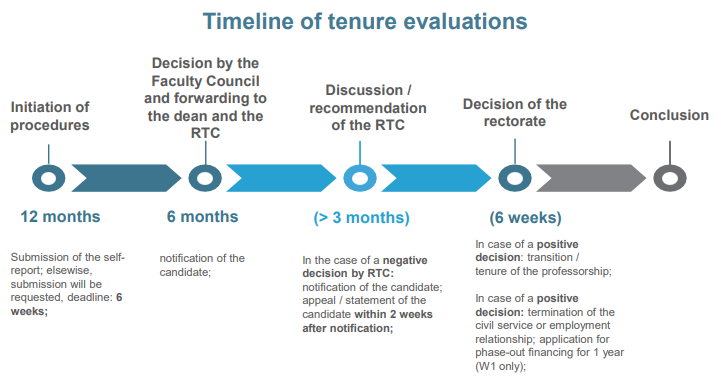
Tenure evaluation
The tenure evaluation is the quality-assured basis for the decision on continuation.
The procedure checks whether the candidate fulfills the tenure criteria and serves as the basis for the decision on the continuation of the employment or service relationship.
Evaluation criteria
A list of criteria by which a tenure track professor will be evaluated. The criteria will be discussed and signed in the first meeting with the dean after acceptance of the call.
Contact us
Nina Reinwald, Dipl. Health Economist
Advisor for Appointment Management
building
Britta Mertesdorf
Tenure Track Procedure and Evaluation Procedure for Temporary (Junior) Professorships
building
details
- Tenure-track procedures and evaluation procedures for fixed-term (junior) professorships
- Planning of the Faculty Colloquium and the introductory event
- Deputy in the absence of Ivonne Hoeck